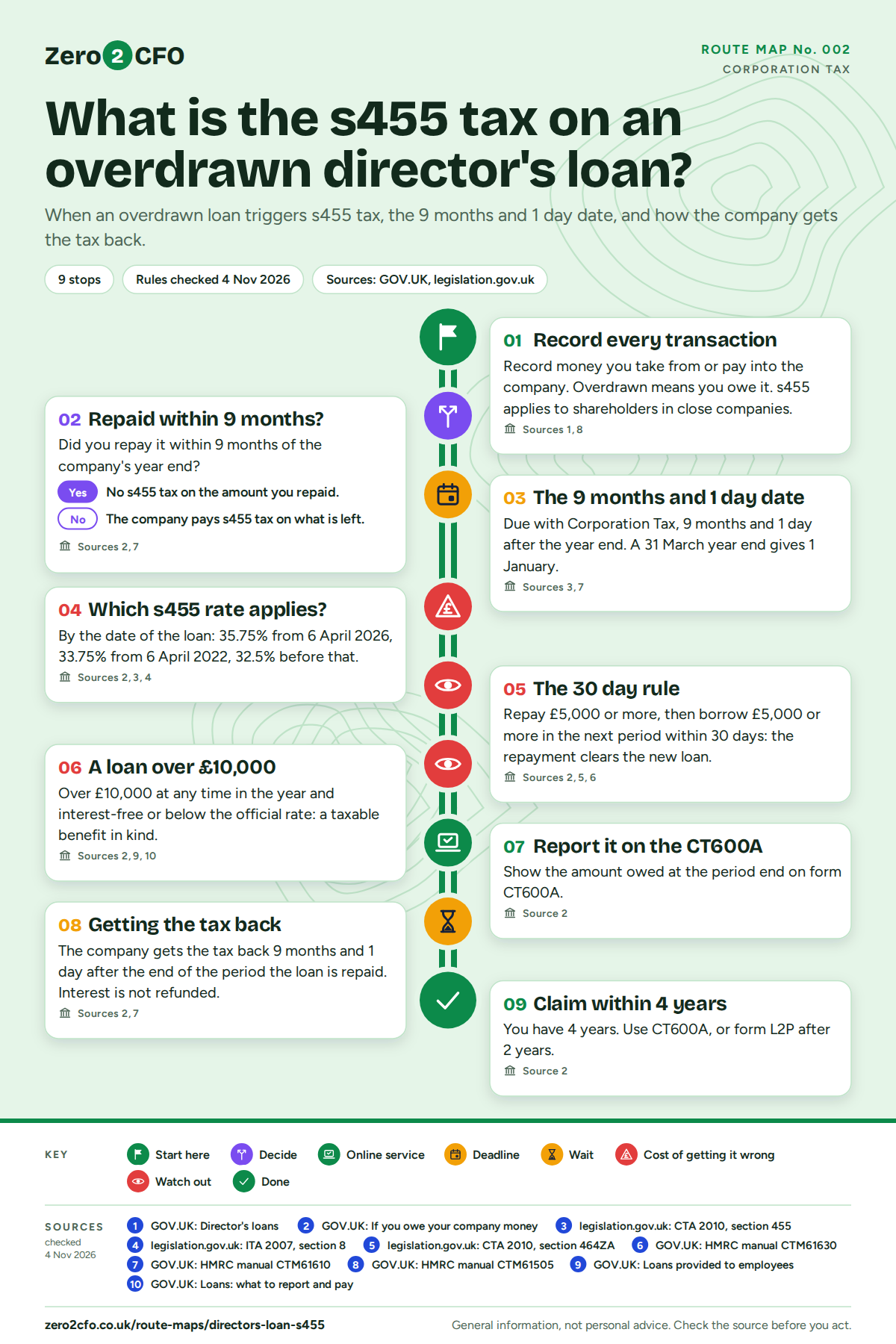
An overdrawn director's loan account means you owe your company money. If you have not repaid it within 9 months and 1 day of the company's year end, the company pays s455 tax on what is still owing. The rate depends on when the loan was made. For loans made on or after 6 April 2026, it is 35.75%. This page is general information, not tax advice.
The route, stop by stop
How the s455 charge works
A director's loan is money you take from your company that is not salary, a dividend or an expense repayment. You keep a record of it. That record is usually called a director's loan account.
The rule is in section 455 of the Corporation Tax Act 2010. It applies when a close company lends money to a shareholder, or to someone connected to them. The company pays the tax, not you. It is due the day after the 9 months that follow the end of the year the loan was made in. That is the same date as the Corporation Tax.
If you repay the loan inside the 9 months, the company does not pay s455 tax on the amount you repaid. The company shows the amount you owe at the year end on form CT600A, with its Company Tax Return.
Which rate applies
The law sets the s455 rate at the dividend upper rate for the tax year the loan was made in.
- Loans made on or after 6 April 2026: 35.75%. This is the dividend upper rate in section 8(2) of the Income Tax Act 2007. Finance Act 2026 changed it for 2026/27 and later years.
- Loans made on or after 6 April 2022 and before 6 April 2026: 33.75%, as shown on GOV.UK.
- Loans made before 6 April 2022: 32.5%, as shown on GOV.UK.
On 4 November 2026 the GOV.UK guidance page still showed only 33.75% and 32.5%. The legislation shows 35.75%. Check both before you rely on a figure.
The 30 day rule
Repaying a loan does not always clear the tax. Say you repay £5,000 or more, and then borrow £5,000 or more in the next accounting period, within 30 days. HMRC treats the repayment as paying off the new loan. The first loan is still owing, so the tax stays. HMRC calls this the 30 day rule. There is a second rule for loans of £15,000 or more, where you arrange to borrow again when you repay.
Loans over £10,000
Say you are a shareholder and director, and you owe the company more than £10,000 at any time in the year. If the loan is interest-free, or the interest is below HMRC's official rate, it is a benefit in kind. The company reports it to HMRC on form P11D and pays Class 1A National Insurance on it. You report the loan on your Self Assessment tax return.
Getting the tax back
The company can claim the s455 tax back once the loan is repaid, written off or released. It cannot claim back the interest. The tax is repaid 9 months and 1 day after the end of the period the loan was repaid. You have 4 years to claim. Within 2 years of the end of the period the loan was made, use the CT600A. After that, use form L2P.
Common questions
What counts as a director's loan?
Money you take from the company that is not salary, a dividend or an expense repayment, and that you have not paid back.
What is the 9 months and 1 day deadline?
It is the day after the 9 months that follow the end of the year the loan was made in. For a 31 March year end, it is 1 January.
Do I pay the tax, or does the company?
The company pays the s455 tax. You may have separate Income Tax or National Insurance to pay if the loan is written off or released, or if it is a benefit in kind.
Can I repay and borrow again?
Not always. The 30 day rule, and a rule for planned re-borrowing, can match your repayment to the new loan. Talk to your accountant about your own position.
Is this tax advice?
No. It is general information from official pages checked on 4 November 2026. Rules and rates change, so check the sources before you act.
Where the rules come from
- GOV.UK: Director's loans checked 4 November 2026
- GOV.UK: If you owe your company money checked 4 November 2026
- legislation.gov.uk: CTA 2010, section 455 checked 4 November 2026
- legislation.gov.uk: ITA 2007, section 8 checked 4 November 2026
- legislation.gov.uk: CTA 2010, section 464ZA checked 4 November 2026
- GOV.UK: HMRC manual CTM61630 checked 4 November 2026
- GOV.UK: HMRC manual CTM61610 checked 4 November 2026
- GOV.UK: HMRC manual CTM61505 checked 4 November 2026
- GOV.UK: Loans provided to employees checked 4 November 2026
- GOV.UK: Loans: what to report and pay checked 4 November 2026
This map is general information, not personal advice. Rules and rates change, so check the sources before you act. If your situation is tricky, talk to your accountant.